

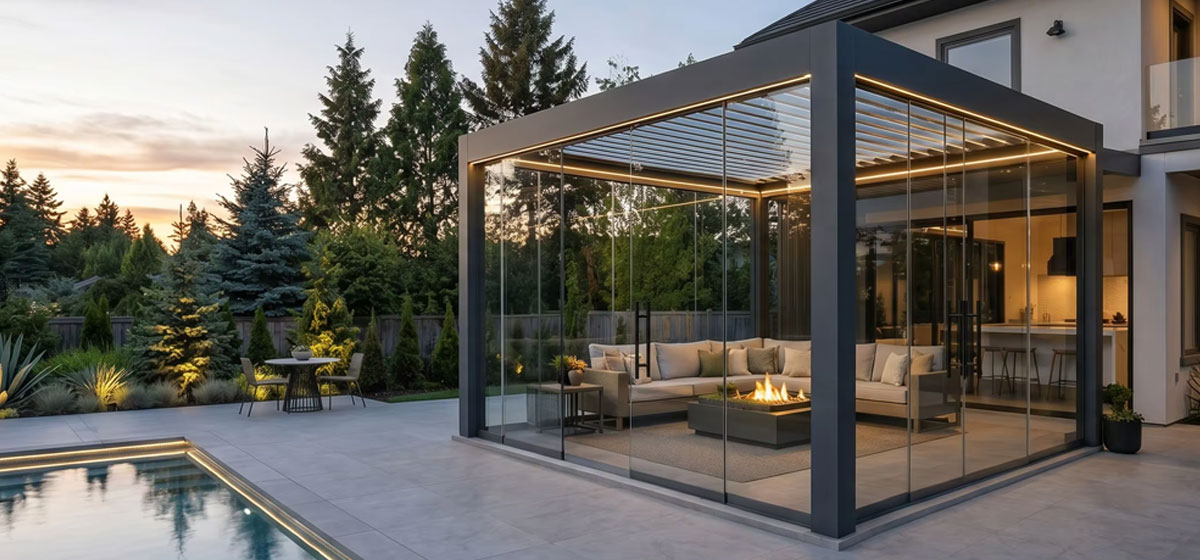
A pergola is designed to provide shade, weather protection, and a comfortable outdoor living space. However, not all pergolas maintain stable performance over time. With prolonged use, some may develop issues such as roof leaks, water pooling, structural movement, or premature aging, which can affect both functionality and overall service life.
In fact, pergola performance issues are closely related to their structural type. Different types of pergolas inherently vary in waterproofing capability and potential failure modes, while design, manufacturing, installation, and maintenance also play important roles.
To better understand why pergolas may leak or fail, we’ll first take a look at several common types of waterproof pergolas and their basic structural differences. From there, we’ll focus on the louvered pergola, the most widely used type on the market, and break down the seven most common issues encountered in real-world use, along with what to consider when choosing a truly reliable, long-lasting solution.
Types of Waterproof Pergolas
Waterproof pergolas on the market generally fall into several main structural types, each with distinct differences in waterproofing performance, user experience, and maintenance requirements.
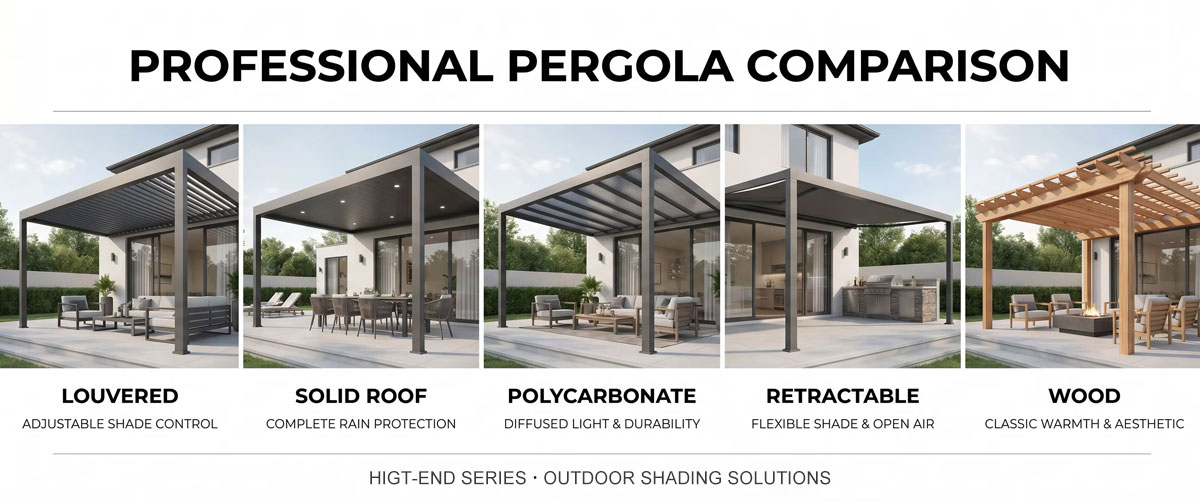
1. Louvered Pergola
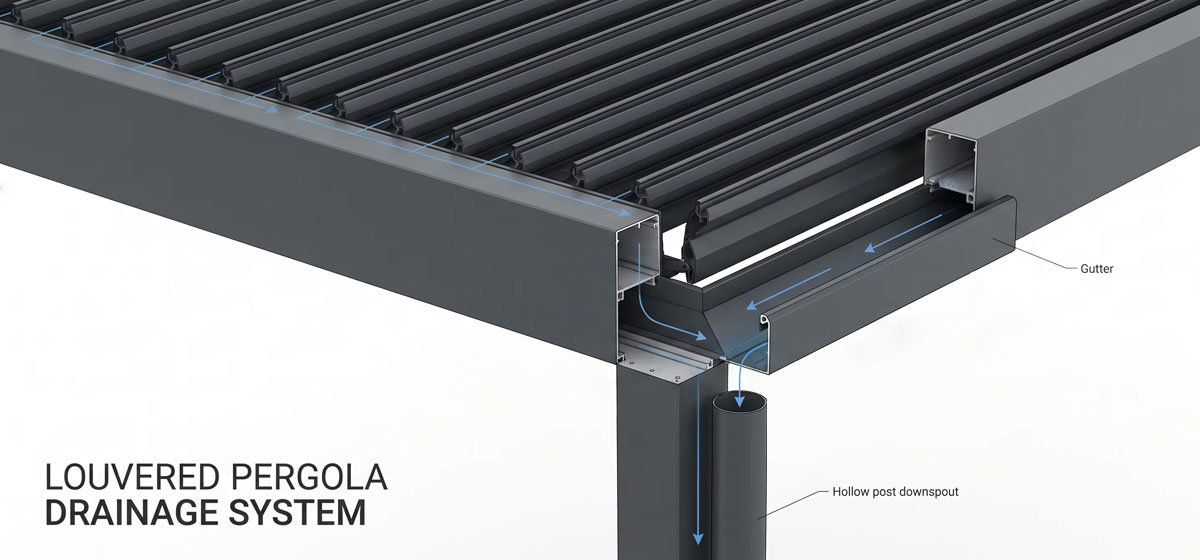
A louvered pergola features adjustable aluminum blades that can open or close to control sunlight, ventilation, and rain protection. When fully closed, it effectively blocks rainwater and works together with an integrated drainage system that channels water through the posts. It is currently the most widely used premium outdoor shading solution.
2. Solid Roof Pergola
This type uses fixed roofing materials such as aluminum panels, steel sheets, or insulated sandwich panels. It offers strong rain protection without relying on moving parts, but has limited flexibility in terms of ventilation and natural light control.
3. Polycarbonate (PC) Roof Pergola
Made with transparent or semi-transparent PC sheets, this type provides basic rain protection while allowing natural light through. However, long-term exposure may lead to aging, yellowing, or sealing issues caused by thermal expansion and contraction.
4. Retractable Pergola
This system uses a retractable waterproof fabric canopy that can be opened or closed depending on weather conditions. It offers high flexibility, but its waterproof performance and durability largely depend on material quality and environmental conditions.
5. Wood Pergola
Wood pergolas are typically made from treated solid timber or engineered wood, offering a natural and visually appealing appearance with stable performance in the early stages of use. However, over time, exposure to sunlight, rain, and temperature fluctuations can cause the wood to crack, warp, fade, or even rot, which ultimately affects both waterproofing performance and structural stability. Compared to other materials, wood pergolas require significantly higher levels of maintenance.
Differences in Failure Mechanisms Across Pergola Types
Different pergola structures follow distinct design logic and waterproofing approaches, which means their failure modes also vary significantly.
For example, wood pergolas are more susceptible to natural material aging; polycarbonate roofs are mainly affected by thermal expansion and joint sealing performance; while retractable fabric systems rely heavily on fabric tension and environmental stability.
In contrast, louvered pergolas are more complex systems that integrate movable roof blades, sealing components, and internal drainage channels. As a result, their waterproof performance does not depend on a single material, but on the coordinated performance of the entire system.
Given these structural differences, we will now focus on the louvered pergola—the most widely used type—and analyze the seven most common causes of leaks and failures.
Why Do Louvered Pergolas Leak or Fail?
Cause 1: Improper Drainage System Design
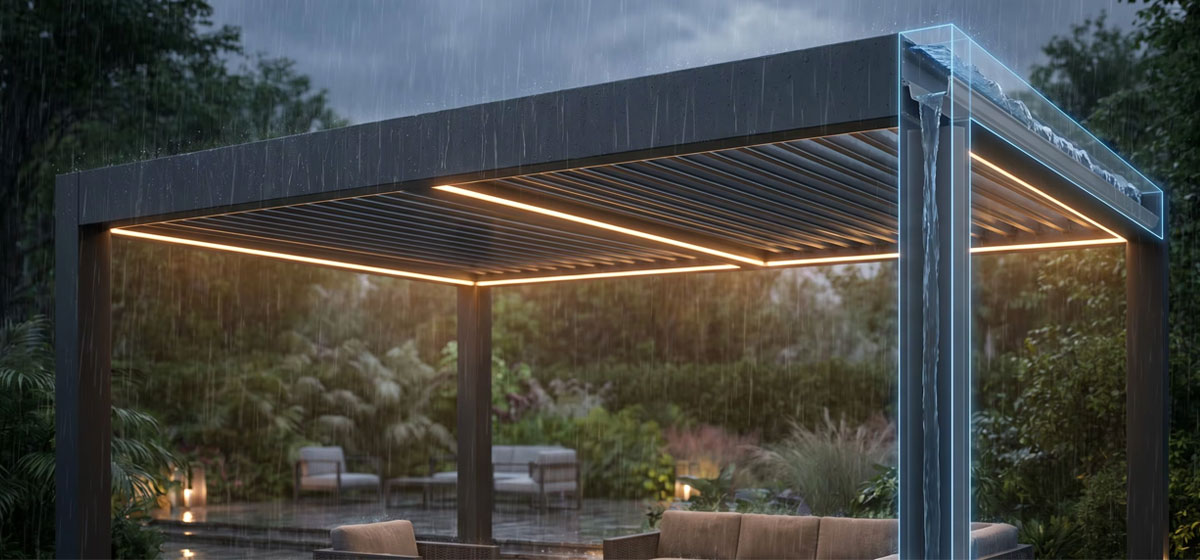
In a louvered pergola system, the drainage design is one of the most critical factors affecting waterproof performance. Even when the roof blades are fully closed, providing effective rain protection, poor drainage design can still lead to water accumulation inside the structure, eventually causing leaks or overflow.
Common issues include insufficient drainage slope, narrow or blocked drainage channels, and improper integration with the internal post drainage system. During heavy rainfall, these weaknesses become more apparent, allowing water to remain on beams or joint areas for extended periods, which increases the risk of leakage.
In addition, some low-quality systems use exposed or semi-enclosed drainage designs, where flowing water is easily affected by wind and may splash back onto structural joints, further reducing overall waterproof stability.
Therefore, a properly engineered louvered pergola must feature a complete drainage path consisting of rapid water collection, internal channeling, and vertical discharge through the posts, rather than relying on simple surface gutters alone
Cause 2: Poor Sealing System Design
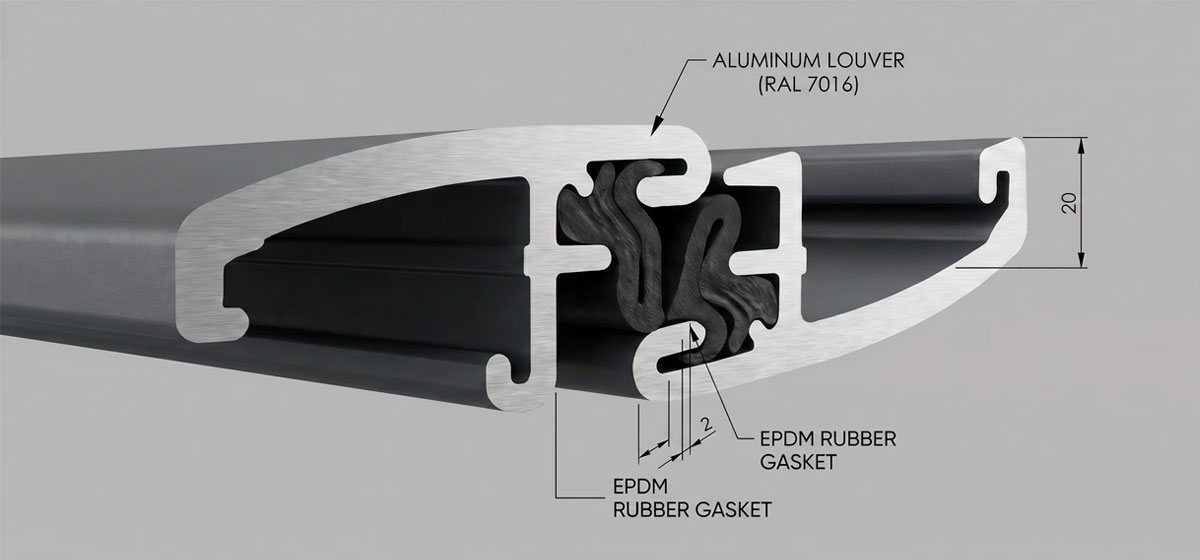
In a louvered pergola, waterproof performance of the roof is critically dependent on the sealing system. Its function is to minimize water ingress between the blades when the louvers are fully closed. However, in real-world applications, many leakage issues are not caused by the blades themselves, but by insufficient sealing design or manufacturing precision.
Poor contact between louver blades, low-quality or aged sealing gaskets, and minor gaps between the frame and blades can all contribute to potential pathways for water ingress. When these issues exist, water may still penetrate through the gaps under wind pressure, even when the system is fully closed.
If manufacturing precision is inadequate, the blades may fail to maintain consistent contact pressure during closure, leading to localized sealing failure. This issue of uneven force distribution becomes especially noticeable under strong wind or heavy rain conditions.
A high-quality louvered pergola relies not only on durable sealing materials, but also on precise fabrication and consistent closing alignment of the entire structure to ensure long-term waterproof performance.
Cause 3: Poor Material Quality
Material-related issues are often not immediately visible at the beginning. Instead, they act as a “slow variable” that gradually affects the overall system performance during long-term use.
For example, if the aluminum profiles lack sufficient strength, slight deformation may occur under long-term wind loads or temperature fluctuations. Although these changes are usually not noticeable, they can affect the alignment accuracy of the louvers when closing, and over time, the sealing performance will gradually deteriorate.
Hardware components follow a similar logic. In high-humidity or coastal environments, if the corrosion resistance is insufficient, deterioration often starts from the connection points. As time goes on, these minor structural changes will gradually affect the overall fit and alignment.
Surface treatment may appear to be only an aesthetic issue, but in fact, it serves as the first protective barrier between the material and the environment. If the coating quality is unstable, long-term exposure may lead to aging or peeling, exposing the underlying substrate to environmental damage.
In most cases, materials do not directly cause leakage. However, they weaken the overall waterproof performance by affecting structural stability over time.
Cause 4: Installation and Construction Errors
Many issues in louvered pergolas are already introduced during the installation stage. The design itself may be sound, but if on-site leveling is inaccurate or the foundation of the posts is not properly aligned, the entire structure may become misaligned when closed.
This misalignment does not usually cause immediate problems, but as the louvers are repeatedly operated, the gaps may gradually increase, allowing water to enter through weakened points in the structure. This effect becomes more noticeable in larger-span systems.
Cause 5: Blocked or Interrupted Drainage Path
In theory, the drainage system is designed as a continuous pathway. However, in real-world applications, this continuity is often compromised by overlooked details.
For example, shallow internal water channels, poorly connected vertical drainage paths inside the posts, or design interruptions at joint points can all prevent water from flowing smoothly. Over time, water may accumulate repeatedly in localized areas, or even flow back into upper structural sections.
Cause 6: Structural Loosening Over Time
A louvered pergola is a dynamic structure, and frequent opening and closing naturally create continuous micro-stress on its connection components.
These stresses do not cause immediate failure, but over time, bolts, hinges, and connection points may gradually loosen. Once the overall structural rigidity decreases, the alignment accuracy between the louvers is also affected, which in turn reduces waterproof performance. Therefore, regular inspection of structural stability is necessary.
Cause 7: Extreme Weather and Environmental Conditions
In many cases, the issue is not that the system is poorly designed, but that environmental conditions exceed its intended design limits.
Strong winds can alter rain trajectories, heavy rainfall can overload the drainage system, and rapid temperature changes can affect material expansion and contraction. Under these combined conditions, even a normally functioning system may experience temporary leakage or localized performance failure.
Can a Pergola Be 100% Waterproof?
Many users researching pergolas often ask a straightforward question: can a pergola be completely waterproof?
From a structural perspective, there is an inherent difference between a standard pergola and a waterproof pergola system. Standard pergolas are primarily designed for shade, while waterproof systems rely on louvered roof closure, sealing components, and internal drainage channels to manage rainwater effectively.
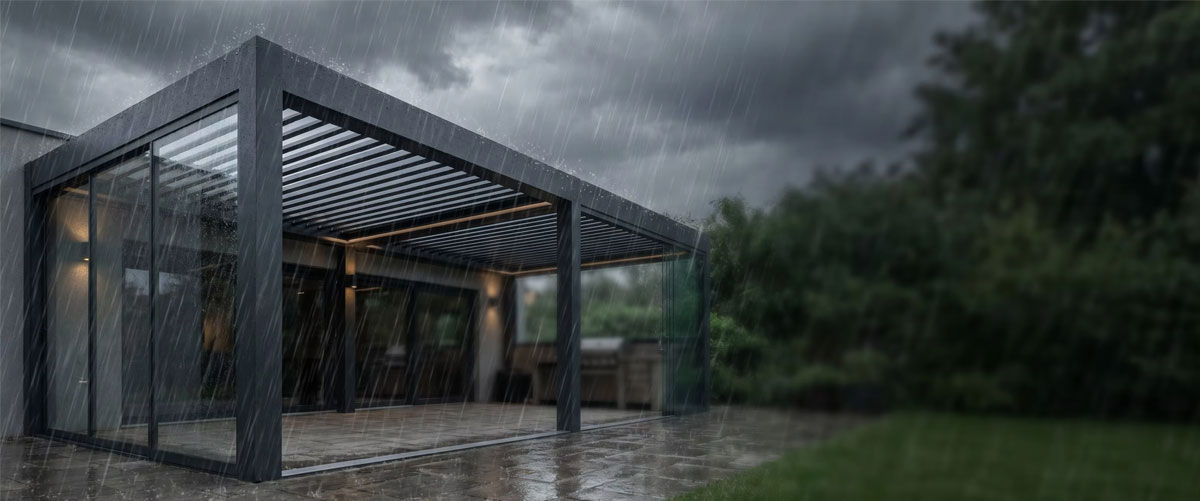
In real-world applications, taking a louvered pergola as an example, when the roof is fully closed, the system can block most rainfall and direct water through the internal drainage structure for discharge. Under normal weather conditions, this results in stable and reliable waterproof performance.
However, under extreme conditions such as heavy rain combined with strong wind, some water may enter through structural gaps due to wind pressure. This is typically influenced by system design quality, sealing precision, and installation accuracy. In well-engineered louvered pergolas, such ingress is generally minimal and is quickly managed through the drainage system without affecting overall usability.
Therefore, instead of focusing on whether a pergola is “completely waterproof,” it is more meaningful to evaluate whether the system offers stable waterproof performance, well-designed water management, and long-term reliability under real outdoor conditions.
How to Choose a Truly Waterproof and Durable Pergola?
When selecting a pergola, the key is not appearance or a single specification, but overall system performance. A reliable waterproof pergola is essentially the result of structural design, material quality, and manufacturing precision working together.
In practical evaluation, the following aspects are worth focusing on:
l Whether the drainage system is fully integrated and continuous
l Reliability and long-term stability of the sealing system
l Strength and weather resistance of aluminum profiles
l Corrosion resistance and durability of hardware components
l Overall manufacturing and fabrication precision
l Wind load and waterproof testing standards
l Installation expertise and workmanship quality
l After-sales service and warranty support
These factors together determine the long-term outdoor performance of a pergola, not just its initial appearance or short-term usability.
Conclusion
The performance of a pergola is never determined by a single factor, but rather by the combined influence of structural design, material selection, manufacturing precision, installation quality, and environmental conditions.
After analyzing different pergola structures and the common failure mechanisms of louvered systems, it becomes clear that most performance issues are not caused by the product type itself, but by differences in system design and overall execution.
Therefore, when selecting a pergola, it is more meaningful to understand the system logic behind the product rather than focusing solely on appearance or individual specifications. A truly reliable outdoor structure is built on the coordinated performance of drainage, sealing, and structural integration.
In real BLD Pergola projects, the focus is on ensuring these systems perform consistently across different climates and usage environments, rather than optimizing a single feature in isolation.
If you are planning an outdoor space and are looking for a more stable and durable solution, feel free to get in touch with us to discuss your specific requirements.