

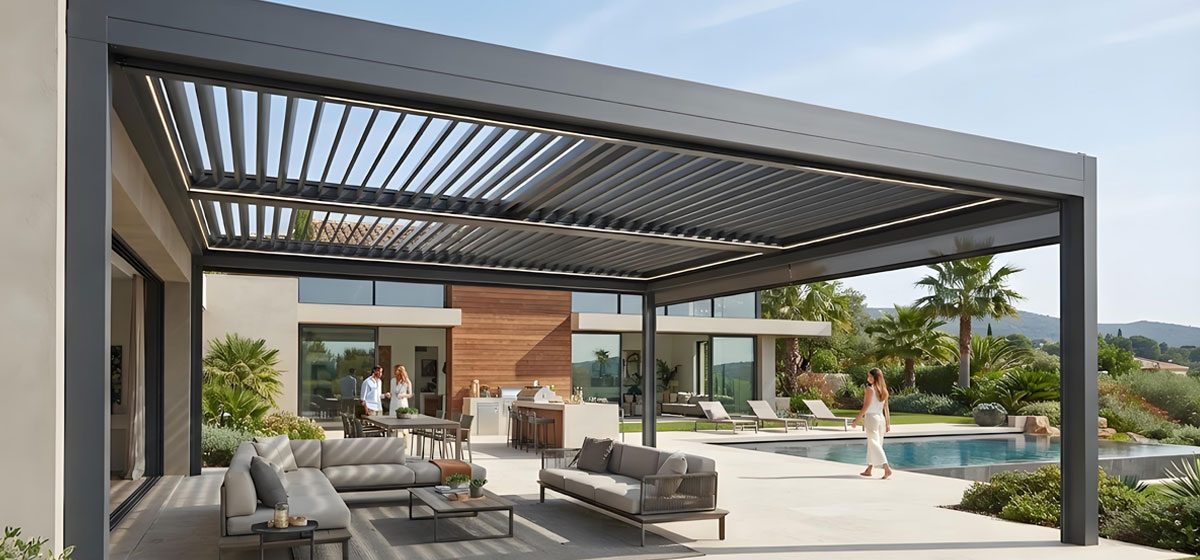
When installing a louvered pergola, size and span are two important factors to consider. Some homeowners prefer not to have a center post because they want a more open and visually appealing outdoor space. However, for a large-span pergola, eliminating the center post is not simply an aesthetic choice—it also affects the overall structural safety and stability.
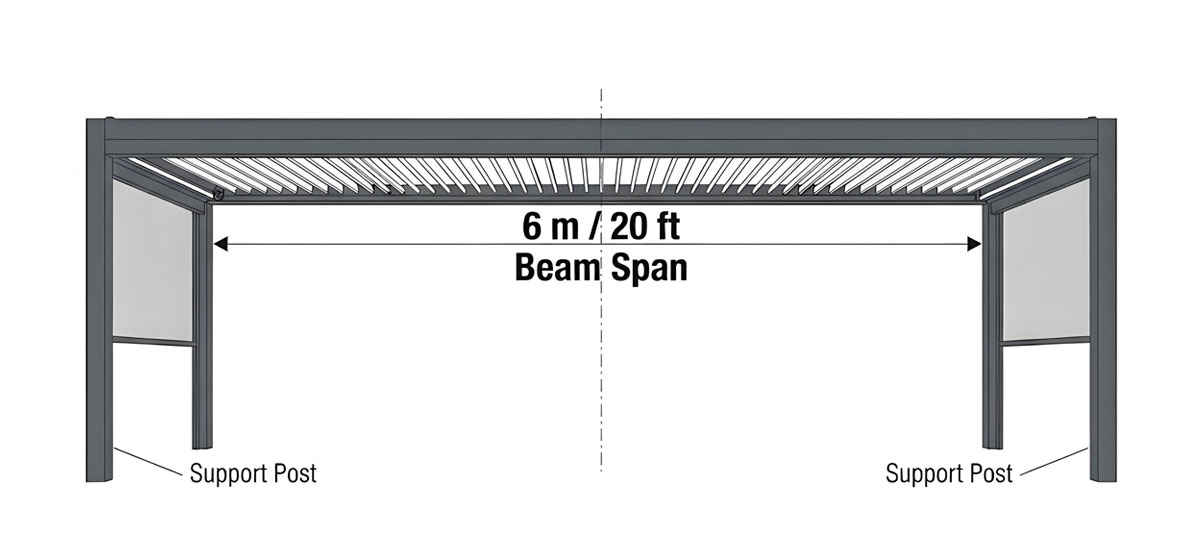
In general, the maximum span of an aluminum pergola is around 6 meters (approximately 20 feet). However, this is not a fixed limit that applies to every pergola. The actual span depends on factors such as the structural design, aluminum profiles, beam size, louver configuration, and local wind and snow loads.
When the span exceeds approximately 6 meters, larger structural profiles, additional supports, or structural reinforcement may be required to maintain structural safety. For some large-span projects, steel beams or a combination of aluminum and steel may also be considered.
So, what factors affect the maximum span of an aluminum pergola? Let’s take a closer look.
Factors Affecting the Maximum Span of an Aluminum Pergola
As the span of an aluminum pergola increases, the load on the beams and the overall structural requirements also increase. At this point, it is not enough to simply consider whether the aluminum is strong enough. Beam stiffness, deflection, and the stability of the entire structure also need to be considered.
Simply put, achieving a larger clear span without a center post is not determined by any single component. It depends on several structural factors working together.
The main factors include the following:
1. Aluminum Strength and Thickness
The first factor to consider is the aluminum profile itself.
The aluminum alloy grade, profile size, wall thickness, and cross-sectional design all affect the beam’s load capacity and stiffness. As the span increases, the demands placed on the beam also increase.
For example, even when two structures are made from aluminum, a larger reinforced profile and a smaller standard profile can perform very differently over a large span.
Another factor that is easy to overlook is deflection.
A beam does not have to break before there is a problem. If the span is too large for the stiffness of the profile, the beam may experience noticeable deflection, which can affect the stability and overall performance of the pergola.
BLD’s adjustable louvered pergola system uses 6063-T5 aluminum profiles and can achieve a maximum span of 6 meters without support beams under specific structural configurations. This is why, when choosing a large-span pergola, it is important to look beyond whether the structure is made of aluminum and consider the specific profile and structural system being used.
2. Overall Pergola Design
The second factor is the overall structural design of the pergola.
It is not just about how wide the pergola is. Other factors include:
l Overall pergola dimensions
l Freestanding or wall-mounted configuration
l Beam layout
l Post placement
l Roof design
l Beam-to-post connections
Here is a simple example.
Two pergolas may both be 6 meters wide, but if one uses a four-post configuration while the other has an additional center support, their structural requirements will naturally be different.
In other words, the overall width of a pergola is one dimension, while the actual distance the beam needs to span is another.
3. Post and Beam Size
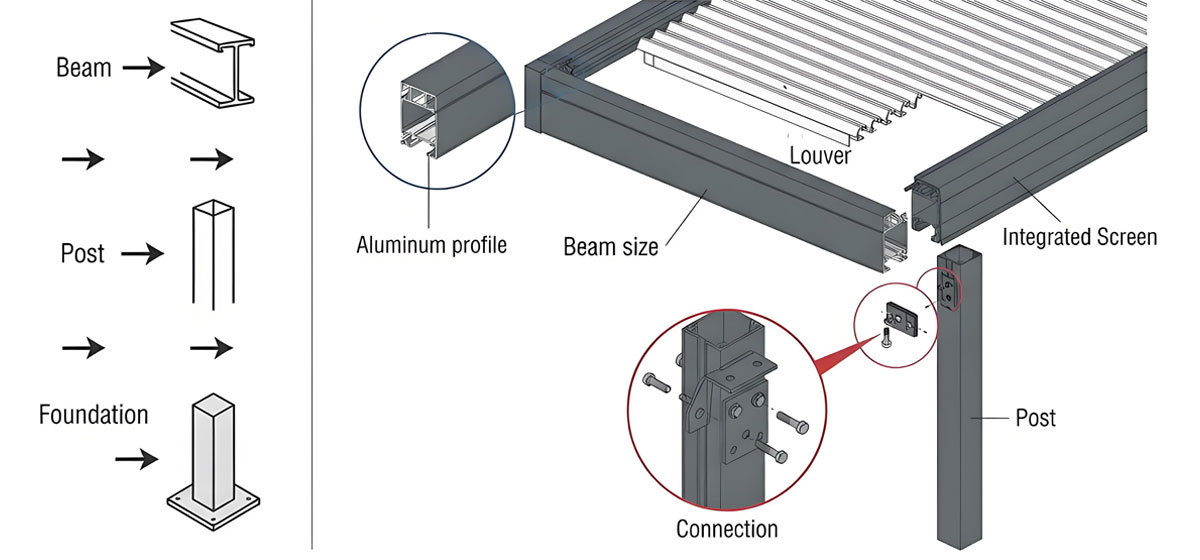
If the goal is to reduce the number of posts and create a more open space, the beams need sufficient load capacity and stiffness. The posts and beam-to-post connections also need to handle the corresponding loads.
You cannot look at the beam alone.
The beam transfers the load to the posts, and the posts transfer the load to the foundation. If one part of the system is not strong enough, simply making the beam larger will not solve every structural issue.
For large-span custom projects, beam and post dimensions can be adjusted according to the required span, structural design, and loading conditions.
4. Louver Orientation and Configuration
With a standard solid-roof pergola, the roof structure is relatively straightforward. With a motorized louvered pergola, however, the louvers themselves are also part of the overall structural design.
The size, length, weight, and orientation of the louvers can all affect how the roof loads are transferred to the surrounding beams and posts.
This is especially important for large-span pergolas. The louver system cannot be considered separately from the main structure and should be designed together with the beam and post configuration.
BLD adjustable louver system supports different louver orientations and configurations, which can be selected according to the dimensions and requirements of the project.
5. Local Wind and Snow Loads
Local weather conditions can also directly affect the maximum span of an aluminum pergola.
For example, a 6-meter-span pergola installed in a typical residential area may face very different structural requirements from one installed in a high-wind coastal area.
Wind Load
The stronger the wind, the greater the forces acting on the pergola.
Coastal areas, high-wind regions, and hurricane-prone areas typically require greater structural capacity.
Snow Load
In areas with snowfall, accumulated snow on the roof adds weight to the pergola and increases the loads on the beams, posts, and connection points.
So when determining the maximum span, it is not enough to ask:
“How far can this pergola span?”
You also need to ask:
“Where will the pergola be installed?”
BLD’s adjustable louvered pergola has undergone relevant testing, with a wind resistance of 180–220 km/h and a snow load capacity of 160–180 kg/m². Corresponding test certificates are available to support these results.
At the end of the day, safety should come first when designing a large-span pergola—not simply how open or attractive it looks. If you want to reduce the number of center posts and create a more open space, it is best to discuss your project with a professional pergola manufacturer during the design stage and choose a structural solution that fits your needs.
What Happens When an Aluminum Pergola Span Exceeds 6 Meters?
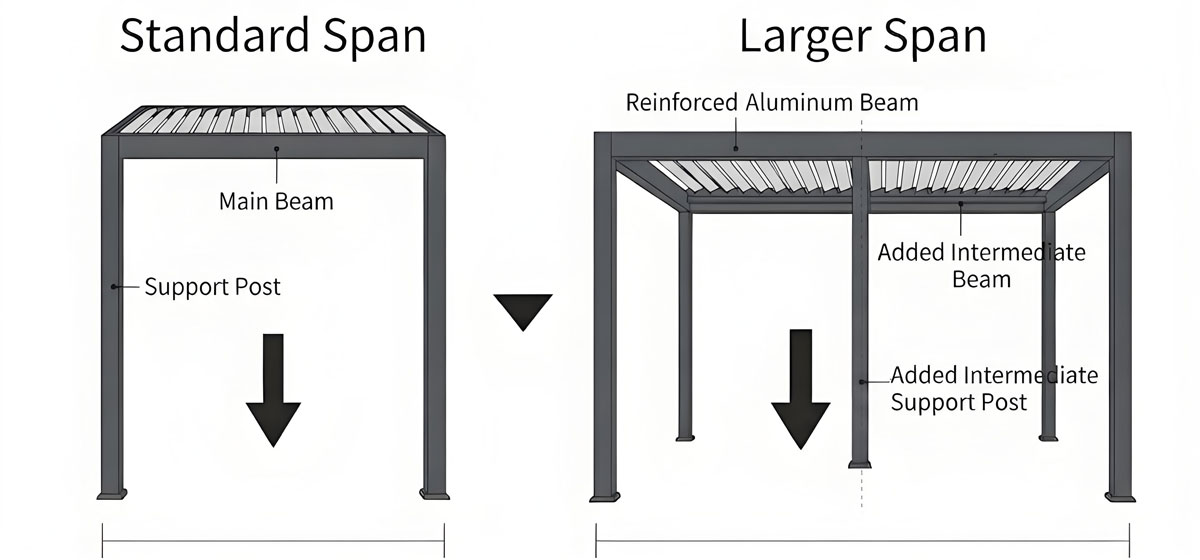
When a project requires a span of more than approximately 6 meters, it does not necessarily mean that an aluminum structure cannot be used. The key is that the structure may need to be reinforced as the span increases.
Depending on the specific project, possible solutions include:
l Adding intermediate beams
l Adding support posts
l Reinforcing connection points
l Using a combination of aluminum and steel
l Using steel beams when necessary
If a standard aluminum beam system cannot provide the structural performance required for a larger span, these approaches can be used to increase the overall structural capacity.
Of course, a larger span comes with a higher cost. Larger beams, more complex structural designs, and additional supports can all increase material, fabrication, and installation costs. As the span increases, the structural requirements generally become greater, and so does the overall project cost.
So, if the goal is simply to create a completely open space by eliminating a center post, it is worth considering whether that is really necessary. In some cases, adding a strategically placed post can simplify the structure while keeping the overall project more cost-effective.
Conclusion
Removing one post can certainly make a space feel more open, but a little more structural consideration can make that openness truly worthwhile.
Six meters can be used as a reference for the span of an aluminum pergola, but every project has its own space and structural requirements. For residential pergolas, good design is not about pushing every inch to the limit, but about making the available space more functional, comfortable, and reassuring.
If you are considering a center-post-free or large-span pergola for your home, tell BLD about your space and requirements. Our professional team can help you determine what span and structural design are truly right for your project.
Frequently Asked Questions
1. Does a 6-meter span refer to the overall width of the pergola?
No. The span generally refers to the distance the beam needs to cover between its supports. It is not necessarily the same as the overall dimensions of the pergola.
2. Is a pergola without a center post always better than one with a center post?
Not necessarily. A center-post-free design creates a more open space, but it usually places greater demands on the beam and overall structure. Whether a center post is needed depends on the specific project.
3. Is the pergola span related to the number of posts?
Yes. Adding posts can shorten the actual beam span and reduce the structural demands on the beam.
4. Does a wall-mounted pergola have the same span requirements as a freestanding pergola?
Not necessarily. The two configurations have different load paths and connection methods, so their structural requirements may also differ.
5. Is a larger pergola span always better?
No. A larger span creates a more open space, but it can also increase structural requirements and project costs. For residential pergolas, there is usually no need to pursue an unnecessarily large span; meeting the actual needs of the space is more important. Commercial projects, however, may require larger spans due to their layout and intended use.