

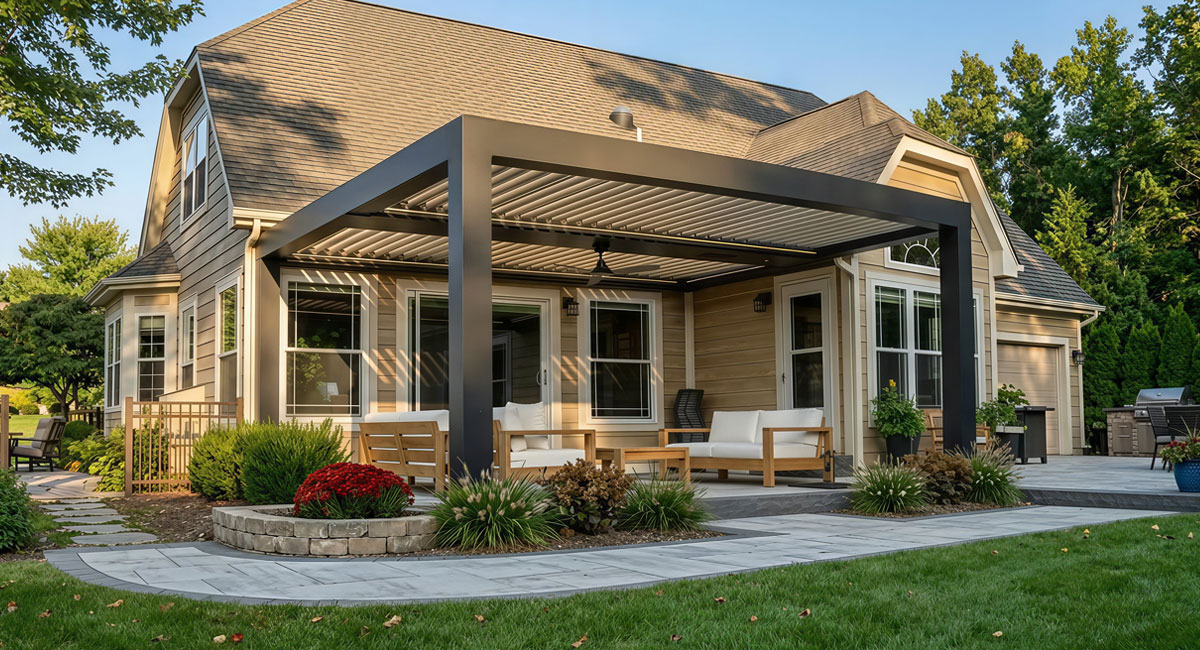
When planning a large aluminum pergola, most people focus on its appearance, size, durability, and functionality. However, one important detail that is easy to overlook is how the structure responds to changing temperatures.
Thermal movement is a key consideration in pergola design, particularly for larger structures with multiple connected components. Understanding how to account for this movement helps ensure reliable performance over time.
Even a small amount of movement can make a difference when multiple components are designed to work together.
Why Thermal Movement Matters in Aluminum Pergolas
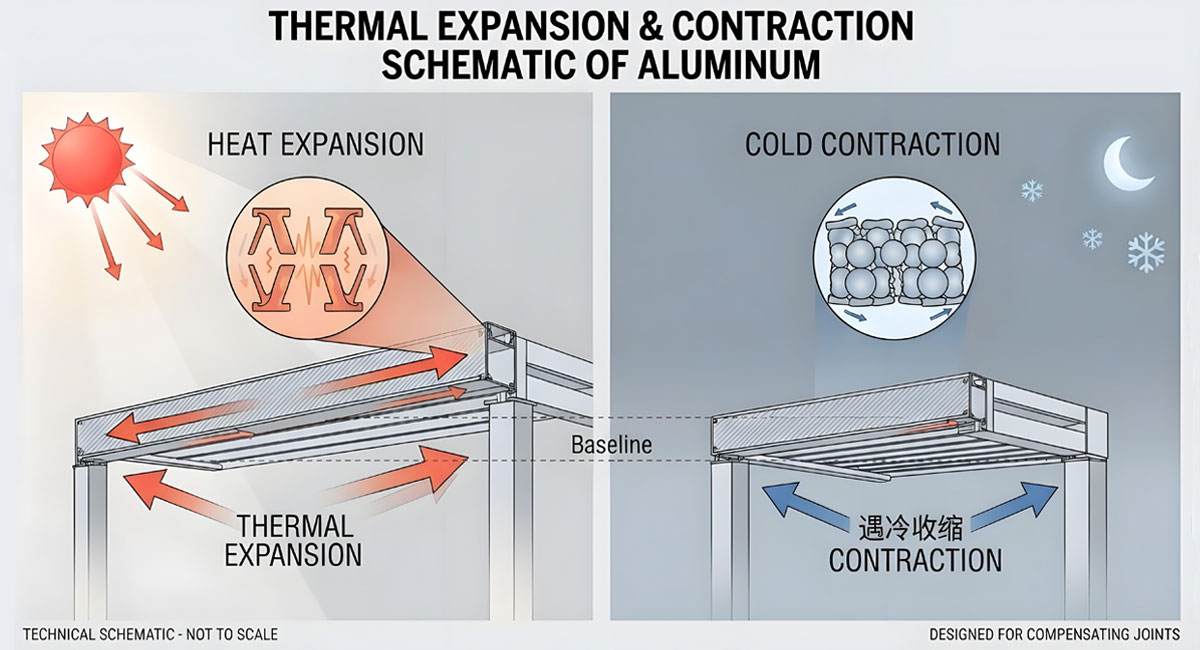
Aluminum pergolas may look like solid, stable outdoor structures, but that doesn't mean every component stays exactly the same over time. As temperatures rise and fall, aluminum naturally expands and contracts. These changes are usually small, but in larger pergola systems made up of multiple connected components, the accumulated movement can become significant.
Aluminum offers an excellent strength-to-weight ratio, corrosion resistance, and good workability, making it a popular material for modern pergola frames, louvers, and other structural components. However, aluminum also has a relatively high coefficient of thermal expansion. As temperatures rise, aluminum components expand along their length. When temperatures drop, they contract.
An aluminum pergola installed in an area with direct sun exposure may experience noticeable surface temperature changes throughout the day and across different seasons. On shorter components, these dimensional changes may be difficult to notice. On longer frames or rows of interconnected louvers, even small changes per unit of length can add up to considerable movement.
Thermal movement itself is not a structural defect. It is a natural response to temperature changes. The real concern is whether the pergola has enough clearance and properly designed connections to accommodate that movement.
When a structure completely restricts the natural movement of its components, thermal expansion and contraction can create additional internal stress. This stress may concentrate around connection points, fixed points, and other restrained areas. Over time, it can affect component alignment, connection stability, and the operation of moving parts.
Thermal movement should be addressed during the initial design of a large aluminum pergola, rather than waiting until alignment or operating problems appear.
How Expansion Gaps Help Aluminum Pergolas Handle Thermal Movement
Since aluminum components expand and contract as temperatures change, the design needs to allow enough room for this natural movement. That's where expansion gaps come into play in aluminum pergola systems.
Expansion gaps are not simply wider spaces between two components. They are carefully planned clearances based on material properties, component dimensions, expected temperature changes, and connection methods.
Why Aluminum Components Need Room to Expand and Contract
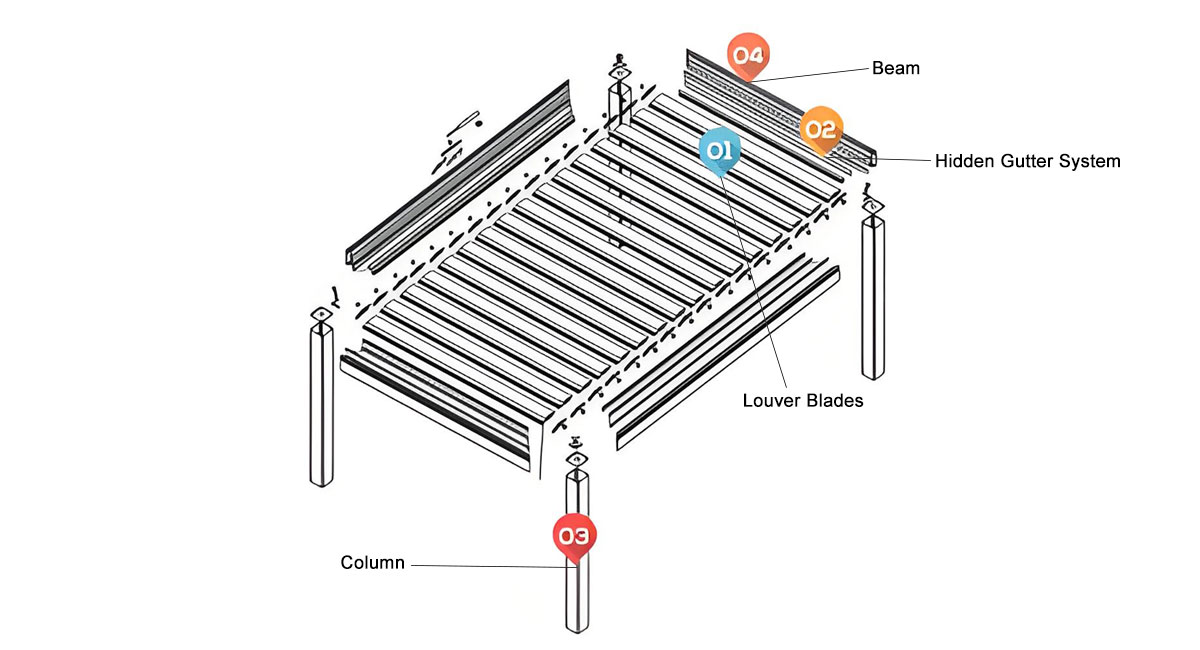
Consider the fit between the louvers and the frame. As temperatures rise, aluminum components expand. If there isn't enough clearance between adjacent parts, expanding components may press against each other, placing additional stress on connection points and interfering with the normal operation of moving parts.
Repeated temperature changes can make these restrictions more problematic over time. They may lead to component misalignment, increased operating resistance, unusual noises, or premature wear around connection points.
Properly designed expansion gaps give components the room they need to move. This reduces unnecessary contact and pressure while helping maintain the correct fit between parts as temperatures change.
What Determines the Appropriate Expansion Gap?
There is no single expansion gap dimension that works for every aluminum pergola. The appropriate clearance depends on several factors:
l Component dimensions: Longer components generally experience greater overall dimensional changes as temperatures fluctuate.
l Material properties: Different materials have different coefficients of thermal expansion. Even under the same temperature change and dimensional conditions, their movement may vary.
l Temperature range: Local climate, sun exposure, and the range of temperatures the materials are expected to experience all affect the design.
l Connection methods: Fixed connections, sliding connections, and other restraint conditions determine the direction and amount of movement a component can accommodate.
l Overall system design: The relationship between louvers, frames, drainage channels, and other components needs to be considered as part of the complete pergola system.
In larger pergolas, designers also need to consider how movement in individual components may affect other connected parts. BLD considers the specific structure, component dimensions, and project conditions when determining appropriate expansion clearances, rather than applying one standard dimension to every project.
For larger structural frames with long spans, dedicated structural expansion joints may also be necessary. Their design involves additional considerations, including structural segmentation, connection restraints, and overall movement requirements. These joints serve a different purpose from the ordinary clearances between individual components and should not be treated as the same thing.
How Thermal Movement Affects Louvers, Frames, and Drainage Systems
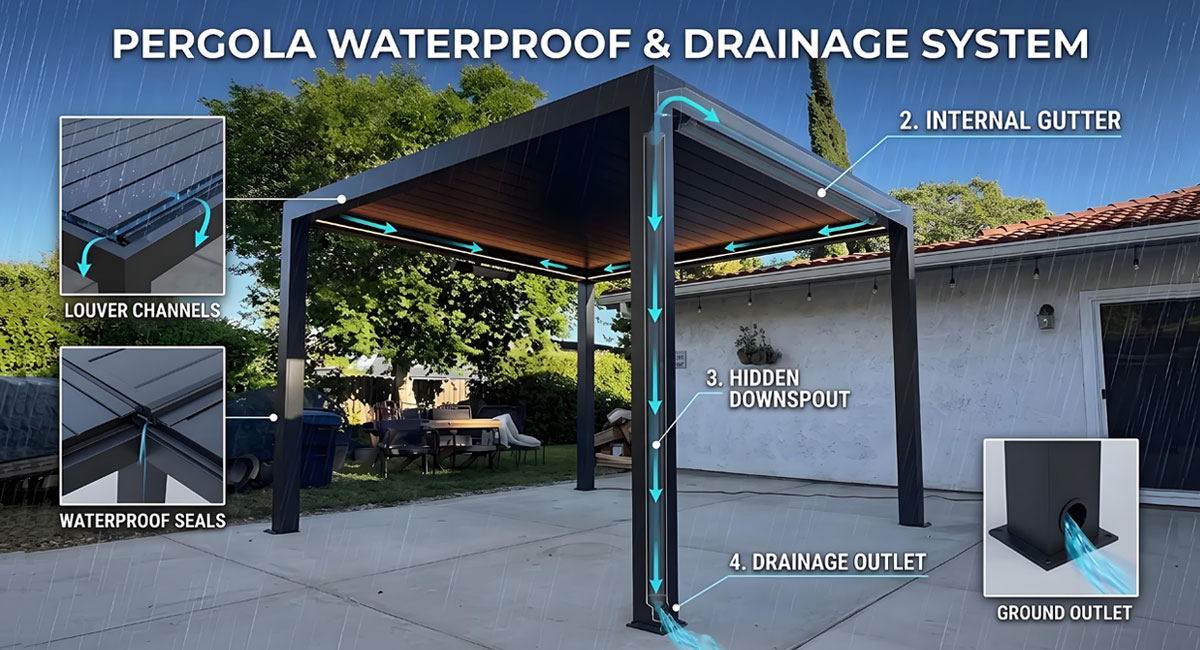
An aluminum pergola is more than just a structural frame. Modern pergola systems often include rotating louvers, integrated drainage channels, motors, drive components, seals, and other supporting parts.
Each component has its own function, but all of them must work together with proper alignment and clearance. Dimensional changes caused by temperature fluctuations can affect how the entire system operates.
Maintaining Proper Alignment Between Aluminum Components
The pergola frame supports and positions the louvers, which rotate within a designated range to control sunlight, ventilation, and rain protection.
If the clearance between the frame and louvers is not properly designed, temperature changes may affect their relative positions. Insufficient clearance can increase the risk of contact and friction between components. Excessive clearance, on the other hand, may affect structural fit, sealing performance, and the overall appearance.
The design needs to account for how adjacent components interact under different temperature conditions, rather than focusing on the dimensional changes of individual parts alone.
Why Louvers May Not Close Completely in Cold Weather
Some pergola owners may notice that their louvers occasionally fail to close completely during colder weather, or that the spacing between blades changes slightly.
One possible reason is the contraction of aluminum components in low temperatures. As the dimensions of the louvers and surrounding frame change slightly, the original clearances may also shift, affecting how the louvers close.
However, not every louver closure issue is caused by thermal movement. Motor performance, drive connections, manufacturing and assembly tolerances, and physical obstructions can also contribute to similar problems. If the louvers consistently fail to close properly, the underlying cause should be inspected.
Allowing Thermal Movement Without Disrupting Drainage
Drainage is another important part of pergola design that can easily be overlooked.
Modern aluminum pergolas often use the louvers, beams, and built-in drainage channels to create a complete water management path. Rainwater needs to flow along its intended route and drain away properly. Connections along this path must accommodate necessary thermal movement while maintaining proper sealing and drainage continuity.
Poorly positioned gaps or sealing details that fail to account for component movement may increase the risk of water leaks. On the other hand, restricting component movement too much in an effort to achieve a completely sealed connection can place unnecessary stress on the structure.
Expansion gaps, connection details, and drainage systems need to be designed together rather than treated as separate elements.
How Proper Design and Manufacturing Prevent Thermal Movement Problems
Managing thermal movement requires more than adding a gap or using a particular connection. For large aluminum pergolas, the key is to identify potential movement requirements during the design stage and ensure that the materials, structural frame, and functional components work together properly.
Designing for Local Climate and Temperature Conditions
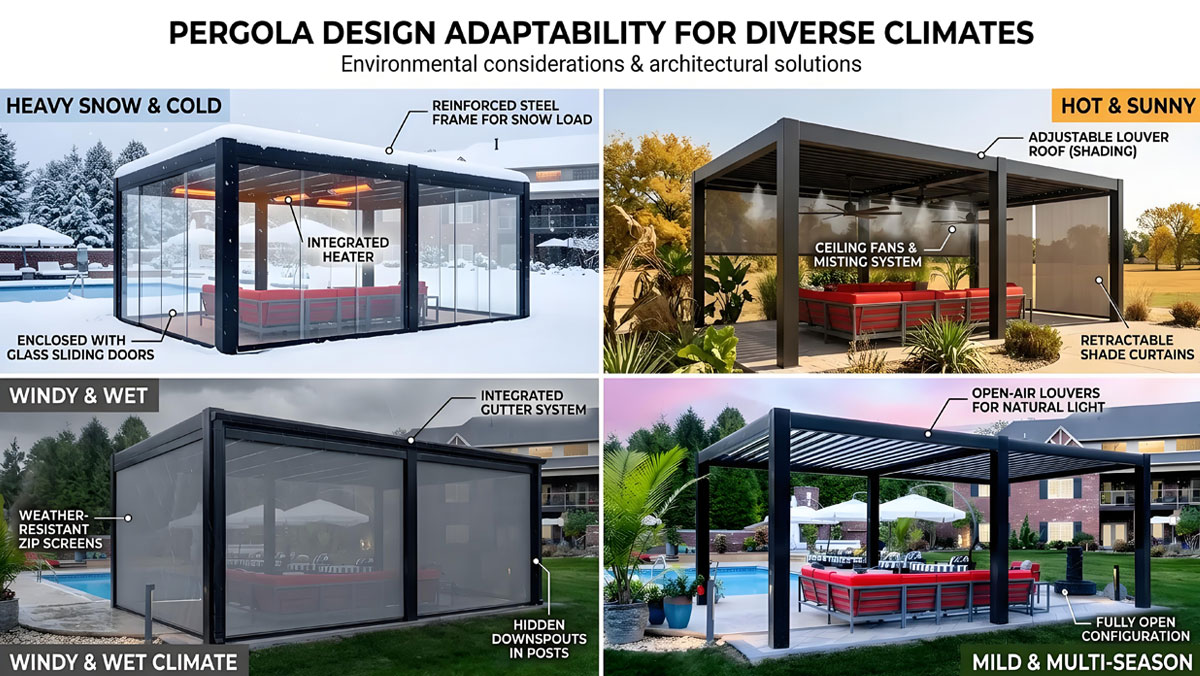
Temperature ranges and outdoor conditions vary significantly from one region to another.
In areas with prolonged exposure to intense sunlight, aluminum components may experience substantial surface temperature changes. In regions with cold winters and significant day-to-night temperature swings, low-temperature contraction and repeated thermal cycling also need to be considered.
Pergola design should account for local climate conditions, the intended outdoor environment, and the overall structural configuration rather than relying solely on standard product dimensions.
BLD has completed pergola projects in countries and regions around the world. Experience across different climates gives BLD valuable insight into potential thermal movement issues. Lessons from previous projects can be incorporated into the design process to identify possible concerns and continually improve structural details and component fit.
Coordinating Structural Connections and Moving Components
Large pergolas typically consist of multiple interconnected structural components. The design must maintain overall frame stability while allowing moving components enough room to operate.
Rotating louvers need to move freely within their intended operating range. Frame connections, meanwhile, must account for how thermal movement can be accommodated under the actual structural restraints.
For projects involving larger structural spans, technical designers may also need to evaluate whether dedicated structural expansion joints are required and how fixed points and movement-permitting connections should be coordinated.
Structural configurations and loading conditions vary from project to project, so the same connection solution cannot simply be applied to every pergola.
Why Manufacturing Accuracy Matters
Even when thermal movement has been considered during the design stage, manufacturing inaccuracies or poor component fit can still affect the final operating performance.
Louver dimensions, frame machining tolerances, connection locations, and the assembly of drive components all influence how smoothly the system operates.
Design requirements must be accurately carried through the manufacturing process. For aluminum pergola systems made up of multiple components, manufacturing precision affects not only the appearance but also how well the individual parts fit and work together.
Factory Pre-Assembly Before Delivery
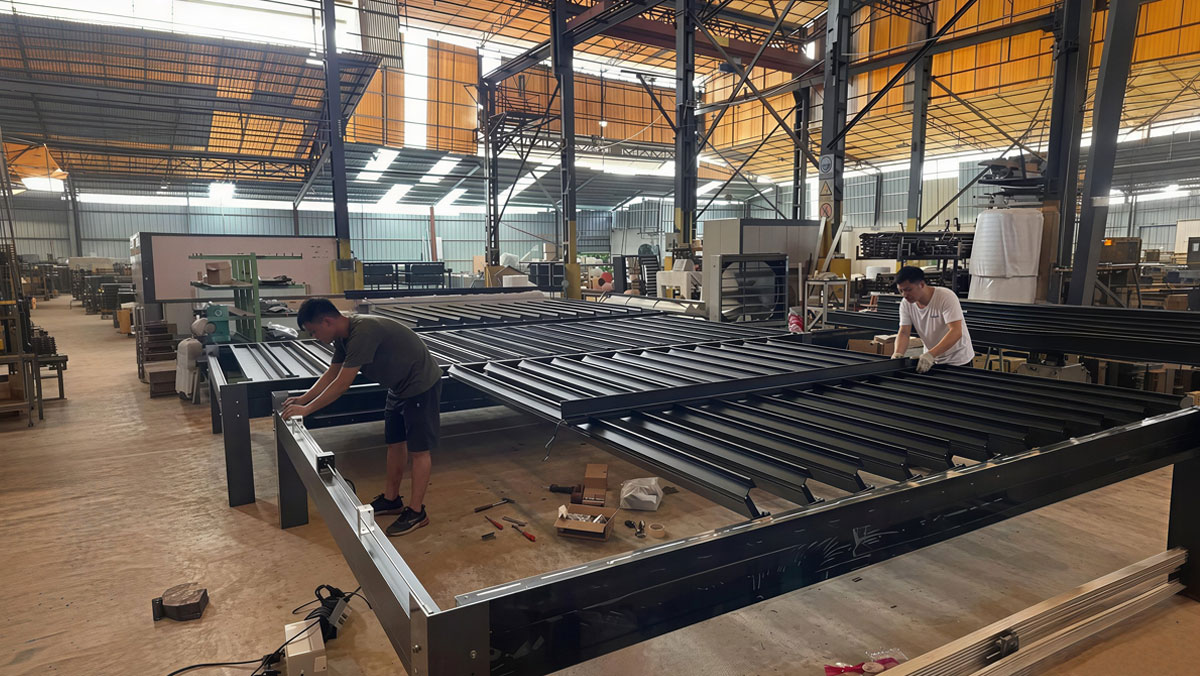
Before products are shipped, BLD carries out factory pre-assembly to check how the pergola components fit together.
This process helps identify dimensional inconsistencies, component fit issues, and abnormal louver operation before the product leaves the factory. Problems that can be caught during pre-assembly can then be addressed before they become issues at the project site.
Factory pre-assembly is an important part of BLD's quality control process.
It is worth noting that factory pre-assembly is primarily intended to verify manufacturing accuracy and assembly fit. It cannot fully simulate every temperature condition or environmental factor the pergola may encounter at the project site. Design considerations, manufacturing precision, and subsequent on-site inspections all play a role in the final result.
What to Do When Your Pergola Louvers Don't Move Smoothly
Even with proper design and manufacturing, outdoor pergolas can be affected over time by temperature changes, dust, debris, and the condition of mechanical components.
If the louvers become difficult to operate or behave unusually when opening or closing, don't immediately try to solve the problem by extending motor run times or forcing the louvers to move.
Check for Visible Obstructions
Check between the louvers, around frame connections, and throughout the moving areas for leaves, dust, branches, or other debris.
What appears to be a thermal movement issue may simply be caused by something physically obstructing a moving component.
Avoid Forcing Stuck Louvers or Moving Components
If the louvers suddenly become stuck during operation, don't keep activating the motor or try to force the blades into position manually.
Excessive force can place additional strain on the motor, drive linkages, and other connected components, potentially making the problem worse.
Inspect Component Alignment and Mechanical Connections
If there are no visible obstructions but the louvers still don't move smoothly, the alignment between the blades, connection points, and drive system may need further inspection.
When problems appear after significant temperature changes, component misalignment, loose connections, and other mechanical issues should all be considered.
When to Contact a Professional
If you cannot identify the cause, or the louvers continue to have trouble closing or moving smoothly, arrange for a qualified professional to inspect the system.
Identifying the actual cause is a better approach than repeatedly operating the system or attempting to adjust structural components yourself.
Designing Aluminum Pergolas for Reliable Performance in Every Season
Thermal expansion and contraction are natural properties of aluminum. In large aluminum pergolas, these changes may not always be visible, but they can affect component fit, structural connections, and long-term operating performance.
Good pergola design needs to account for more than appearance and dimensions at the time of delivery. It must also consider how the product will perform under different temperature conditions.
From the expansion gaps between individual components to structural expansion joints in larger frames, as well as louver operation, drainage systems, and manufacturing precision, every part of the system needs to work together.
Putting Thermal Movement Considerations into Practice
For BLD, thermal movement is not just a material consideration. It is an important part of the overall pergola design and manufacturing process. By considering local environmental conditions, structural requirements, and actual project needs, and by carrying out careful assembly inspections during production, BLD works to reduce the impact of temperature changes on product performance.
A well-designed and precisely manufactured aluminum pergola should perform well not only when it is first delivered but also as it experiences seasonal changes throughout years of outdoor use, providing a comfortable and dependable outdoor space.
If you're planning a large aluminum pergola project, contact BLD to discuss pergola design solutions suited to your structural requirements and local climate conditions.